
August and September are the right time to do this — not November, when the mice are already inside. By late October, Henrico County's outdoor rodent populations (which have been building since May) are actively seeking structural warmth. If there's a gap in your crawl space vents or a failing seal at a pipe penetration, that's when it gets used. The checklist below covers what to look for and what to do about it before the push begins.
Start Outside: Foundation and Ground Level
The exterior walkthrough is where most entry points are found. Do it in full daylight with a flashlight for the crawl space.
Crawl space vents
These are the single most common entry point in Henrico's pre-1980 housing stock. The original galvanized metal screening corrodes in Virginia's humidity — often within 15–20 years. Press on the screen. If it is soft, crumbles, or has any visible holes or gaps, it needs to be replaced. The right material is 1/4-inch galvanized hardware cloth, cut to fit and secured with screws and washers or a galvanized frame. Staples alone will fail. Expanding foam will not stop a rodent.
Pipe penetrations at the foundation
Every place a pipe, conduit, or utility line enters through your foundation or exterior wall is a potential entry point. Gas lines, water supply, condensate drains, electrical conduit — run your hand around each one. If you can feel airflow, or if the sealant has pulled away from the pipe or the concrete, that gap needs to be addressed. For small gaps (under 1/2 inch), copper mesh pushed into the gap and sealed with exterior silicone caulk is the right approach. For larger gaps, use galvanized hardware cloth first, then caulk over it.
Garage door floor seal
The rubber or vinyl seal at the bottom of your garage door needs to make full contact with the floor when the door is closed. Get down to floor level with a flashlight and look for light coming through. Any gap larger than 1/4 inch is a mouse entry point. Replacement garage door bottom seals are inexpensive and straightforward to install.
Foundation cracks and settling gaps
Look specifically at the corners of your foundation and anywhere the foundation meets a different material. Settlement cracks develop over time. Cracks wider than 1/4 inch at or above grade should be filled — hydraulic cement for masonry, hardware cloth plus caulk for larger openings.
Work Your Way Up: Mid-Structure
HVAC line sets
Your air conditioning unit has refrigerant lines running from the exterior compressor through an exterior wall into the interior air handler. The hole cut for those lines is almost always larger than the lines themselves, and it is rarely sealed to rodent-proof standard during installation. Pull back any foam wrap around the penetration and look at the gap. Use copper mesh packed into the gap, then seal around it with silicone caulk.
Dryer vent and exhaust fans
Dryer vents and bathroom exhaust vents that exit through the exterior wall have dampers that should open only when in use. If the damper is stuck open or the surrounding sealant has failed, it is an entry point. Check that the damper moves freely and closes fully when the appliance is off.
The Roofline: Roof Rats Enter Here
This section matters most in western Henrico — Short Pump, Wyndham, Glen Allen's wooded sections — where roof rat activity is documented. If you have mature trees with branches within 3 feet of your roofline, you have roof rat access risk regardless of what is at ground level.
Gable vents
Look at your gable vents from outside. They should have intact mesh backing. If the mesh is missing or damaged, roof rats and large mice can enter directly into the attic. 1/4-inch hardware cloth cut to fit and secured on the interior side of the vent is the fix.
Soffit and fascia gaps
The intersection of the soffit and fascia can develop gaps as the structure settles or wood materials shrink. Walk around the exterior and look up at this intersection. Any visible gap should be closed with metal flashing or hardware cloth, not just caulk — which rodents can chew through.
Tree branch clearance
Prune any branch within 3 feet of the roofline. This removes a physical bridge to roofline entry points. It does not replace exclusion work, but it removes the access route entirely.
What to Leave to a Professional
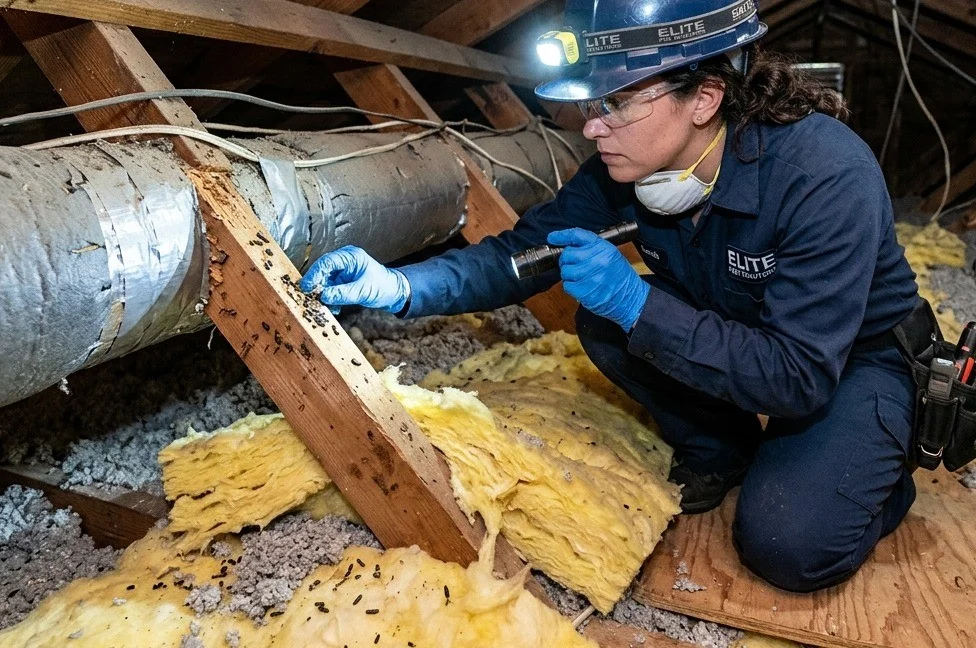
There is a meaningful difference between the preventive steps above and a full exclusion inspection. A professional inspection finds the entry points you cannot easily see: inside the crawl space, under the subfloor, in the attic at roofline junctions. If you have done the checklist above and still find evidence of activity in October or November, that means there is an entry point you have not found. A professional exclusion inspection runs $75–$150 for a residential property, credited toward treatment if you move forward.
Call us at (804) 606-1376 — available 5:00 AM to 11:00 PM ET, every day.
Related Reading
- Rodent Exclusion Service
- What a Full Inspection Covers
- Why Henrico Homes Are Especially Vulnerable in Fall
Ready to Get Rid of Rodents?
Call us now — we answer 7 days a week, 5:00 AM – 11:00 PM ET, 7 days a week. Describe the problem and we'll get someone to you as soon as possible.