
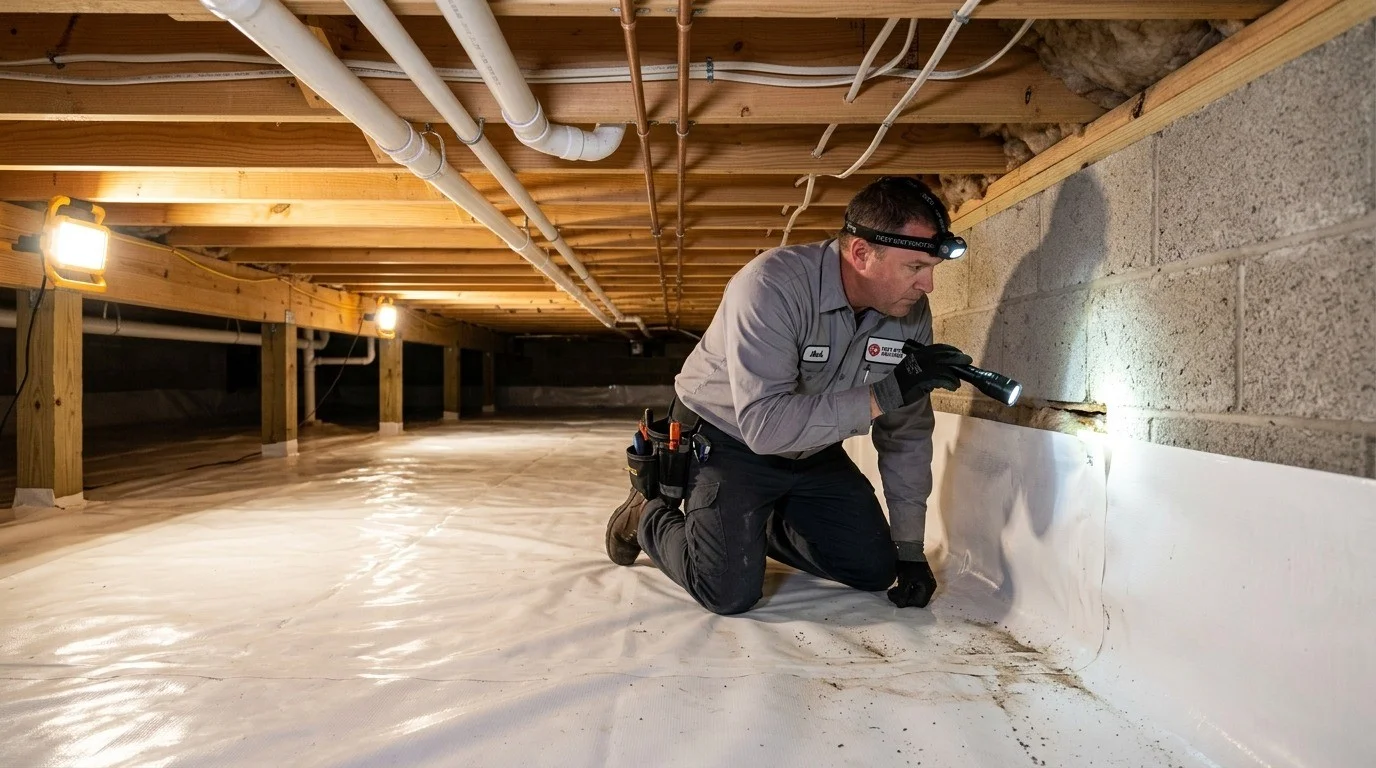
The crawl space is the most common entry point and harborage site for mice in Henrico County's older housing stock — and it is also the part of the home that most homeowners never enter and rarely think about. This combination is why crawl space mouse infestations are so persistent. They develop slowly, out of sight, and by the time the homeowner notices evidence in the kitchen or walls, the colony below has been established for months.
Why Henrico Crawl Spaces Are High Risk
A large proportion of Henrico County's residential properties were built between the 1940s and 1980s on crawl space foundations. These homes share a common vulnerability: the original crawl space vent screens were galvanized metal mesh, and galvanized metal corrodes in Virginia's humid climate. Most of these screens have been failing for decades. In homes we inspect throughout Chamberlayne, Lakeside, Sandston, Highland Springs, and older sections of Glen Allen and the Varina corridor, failed or partially failed vent screens are present in the majority of properties.
A failed vent screen — one with holes, rust-through gaps, or missing sections — is a continuous open invitation. The outdoor population that builds through Henrico's warm months has direct access to the crawl space interior. Once inside, mice nest in the crawl space insulation (if present), along the foundation perimeter, and in any accumulated debris. From the crawl space, they access the living space through pipe chases, HVAC plenums, gaps in the subfloor at utility penetrations, and floor register openings.
Signs of Crawl Space Mouse Activity
You may not need to enter the crawl space to see the first signs. From above:
- Kitchen odor: A persistent musty or ammonia smell from kitchen cabinets, particularly lower cabinets near the toe kick, can indicate mouse activity in the subfloor space directly below
- Floor-level noises: Scratching sounds at floor level — distinct from wall-level sounds — suggest activity in the crawl space or subfloor rather than the wall void
- Droppings in the lowest cabinet drawers: The drawer immediately above the toe kick is one of the most common mouse access points from below
- Evidence in garage at floor level: If the garage has a crawl space below or shares a foundation with the main home, activity in the garage at floor level often traces to crawl space access
Inside the crawl space (with appropriate protective equipment):
- Droppings along the foundation perimeter and near pipe penetrations through the foundation wall
- Disturbed or torn vapor barrier sections where mice have nested underneath
- Gnaw marks on wood floor joists and subfloor decking
- Shredded insulation batts (if crawl space insulation is present) that have been used as nesting material
- Visible vent screen failure — holes, rust-through sections, or completely missing screens
Why the Problem Does Not Resolve on Its Own
Homeowners often try store-bought traps in the kitchen or under cabinets, catch some mice, and see reduced activity for a few weeks. Then it comes back. This cycle repeats because the traps are addressing animals inside the living space while the crawl space colony below — which is connected to the outdoor population through the failed vent screens — continues to replenish the supply.
The mouse you caught in the kitchen trap was the most adventurous member of a colony that may number 20 to 50 animals in the crawl space. Trapping in the living space does not meaningfully reduce a crawl space colony. Treatment needs to happen in the crawl space itself, combined with exclusion of the entry points that connect it to the outdoor population.
What a Complete Crawl Space Mouse Treatment Looks Like
- Inspection: Full crawl space walkthrough — vent screens, pipe penetrations, subfloor gaps, vapor barrier condition, and activity mapping to identify where the colony is concentrated
- Treatment: Snap trap placement at activity locations along the foundation perimeter and near known nesting areas
- Exclusion: Replacement of failed vent screens with 1/4-inch galvanized hardware cloth; sealing of pipe penetrations through the foundation wall; closing any additional identified entry points at the subfloor
- Follow-up: Checking trap placements, removing catches, and confirming activity decline over time
- Confirmation: Treatment is considered complete when inspection shows zero new activity signs in both the crawl space and the living space over a multi-week monitoring period
The Case for Acting Before Fall
In Henrico County, the crawl space mouse push intensifies in October as outdoor temperatures drop. The mice that are living in the yard and garden all summer are the same ones that enter through the crawl space vents when the weather turns. Sealing the entry points in August or September — before the pressure begins — is faster and cheaper than treating an established infestation in November.
A crawl space exclusion inspection is $75 to $150 for a residential property. If entry points are found and sealed before fall, that cost prevents what would otherwise be a $300 to $600 treatment job in October or November. Call us at (804) 606-1376 to schedule a preventive inspection before the season changes.
Related Reading
- Crawl Space Rodent Control Service
- Exclusion and Entry Point Sealing
- How to Rodent-Proof Your Home Before Winter
Ready to Get Rid of Rodents?
Call us now — we answer 7 days a week, 5:00 AM – 11:00 PM ET, 7 days a week. Describe the problem and we'll get someone to you as soon as possible.